

Preparatory Work
Partner universities were required to prepare course material for degree programmes and Train-the-Trainers Workshops (TTTWs) to help trainee and existing teachers to further develop and upgrade their pedagogical skills.
The material covers best practices related to E-Education, subject and learner-centred teaching methods, the role of teachers in the educational sphere, diversity in the classroom and other topics crucial to modern-day teaching. Thus, upon completion of the TTTW programme at teacher training centres in Cambodia, participants will be able to implement their newly-acquired contemporary teaching skills to engage all students in classroom activities and thus learn new ways to help students reach their full potential.
The Underlying Idea This was based on identifying a series of modules which built on each other to give an overall picture of the current status and trends in the development of learner-centred strategies. To this end, each module should comprise a sequence of four reinforcing ‘steps’.
Step 1: Background Theory
Step 2: Experience-Sharing
Step 3: (Self-) Reflection
Step 4: Practice
Preparation of Five Core Modules The initial focus was the production of five modules which were mainly designed for primary school teachers, but with contents generally applicable at all educational levels:
Module 1: Building Blocks of Primary Education (with contributions from PUC)
Module 2: Excellence in Teaching (with contributions from UC)
Module 3: Learner-Centred Primary Education (with contributions from UC)
Module 4: Embracing the Differences (with contributions from PUC)
Module 5: Digital Teaching and Learning (with contributions from PUC)
In addition, material from particular modules can be incorporated into existing or new courses in formal degree programmes to promote upgrading and the transition to blended learning.


In addition, a sixth module was prepared on Cross-National Perspectives. This stand-alone on-line course includes PowerPoint presentations on the education systems of each of the four countries participating in the project, with UC being responsible for the Cambodian contribution. The aim is to encourage teachers to reflect on their professional roles from a cross-national perspective in the context of global strategies and challenges to teacher education (e.g. child-friendly school policies, meeting Sustainable Development Goal 4, etc.) and thereby enhance their teaching skills.

Initial Preparation of Translations These outputs were developed in English and subsequently translated into Khmer, Sinhala and Tamil, together with the supporting web-pages. A web-site including the resulting pdf files and video material was created on the open-source OPAL platform by a team in TUD. All the material is open source and freely available for all to use and adapt to their own purposes, with due accreditation.

In parallel with this was the EU Erasmus+-funded establishment of a dedicated E-Learning Center.
Establishment of the CONTESSA E-Learning Centre In order to facilitate blended learning and the development of on-line classes, part of the EU-backed Erasmus+ package was the setting up of an E-Learning Centre in each of the partner universities in Cambodia and Sri Lanka. This was based on the recommendations of a team from TUD after site-visits to review the needs, with the various items being purchased after the appropriate tendering procedures.
- Dedicated 40 Mb internet connection for three years.
- Video Conference System: Logitech Rally and Ultra-HD Conference Cam System with Automatic Camera Control
- Camera plus accessories: Sony Alpha A7M3Body
- Projector: Sony VPL-CH370 5000 Lumen WUXGA 3LCD
- Motorised screen: Meki Magna (96''*96")
- Desktop computers: 20 Dell OptiPlex 3280 AIO, 8Gb RAM
- Laptop computers: two Lenovo ThinkPad X1 C7 Core i7-10510U 16Gb
- Printer: Epson L6190 Color Inkjet
- Microsoft Windows 10 Pro 64bit (life-time license)
- Kaspersky Internet Security (one year license)
In UC, this is located in Room 502, next door to the College of Education office and on the same floor as the College of Science and Technology.
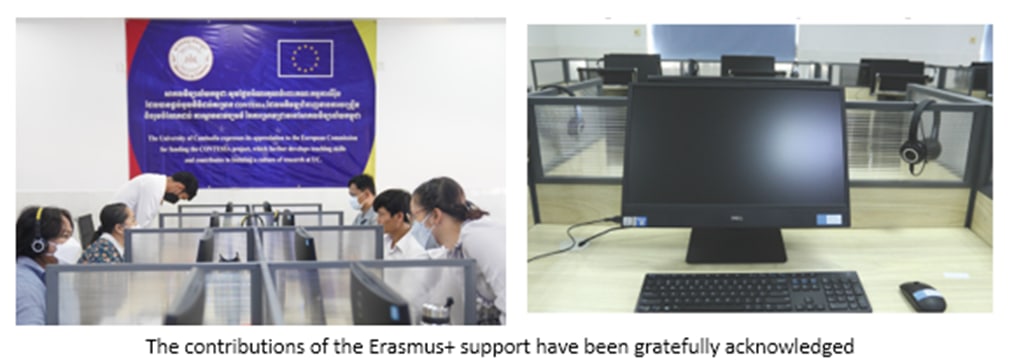
For teaching, this provides a convenient way for small groups of students to be taught in a blended learning environment: as well as for recording and/or net-casting lectures. For research, the fast internet connection allows for the easy downloading of large mp4s and other such files for review and distribution; as well as for the presentation of the resulting findings to small groups or over the internet.
Thus, in theory, the groundwork was laid for testing of the overall concept and the means for its implementation … but then COVID-19 reared its ugly head.